Digital Twins have become one of the most discussed topics across engineering industries, but the concept is often misunderstood. Are they simply simulations? Are they just digital models? What makes them different?
This tutorial introduces the origins, concepts, and key benefits of Digital Twins.
Where Did the Digital Twin Concept Come From?
The roots of Digital Twin technology can be traced back to NASA’s space programs.
During the Apollo 13 mission, after the oxygen tank explosion, engineers used simulators and detailed spacecraft models to understand the failure and evaluate possible solutions before astronauts executed them. These virtual representations became critical tools for decision-making and mission recovery.
Several decades later, NASA researcher John Vickers formally introduced the term “Digital Twin”. His vision was to create, test, and optimize equipment in virtual environments before and during operation.
What Is a Digital Twin?
A digital twin is a virtual representation of a physical object or system that uses real-time data to accurately reflect its real-world counterpart’s behavior, performance and conditions.
Digital twins enable continuous monitoring, simulation and analysis of an object, product or system over the course of its lifecycle, from design and production to maintenance and decommissioning. They can also incorporate external processes and critical variables that affect an asset’s performance.
A Digital Twin is a virtual representation of a physical asset or system that continuously exchanges information with its real-world counterpart.
Three characteristics distinguish a Digital Twin:
- High-Fidelity Modeling
The virtual model represents the physical asset with sufficient accuracy to reproduce its behavior under different operating conditions. - Live Data Integration
Measurements from sensors, SCADA systems, IoT devices, and other data sources continuously update the virtual model. - Bidirectional Feedback
Insights generated by the digital twin can support planning, maintenance actions, operational decisions, and even automated control actions.
This creates a continuous loop between the physical and digital worlds.
Physical Asset → Data Collection → Digital Model → Analysis → Decisions → Physical Asset
The Four Building Blocks of a Digital Twin
A successful Digital Twin typically combines four elements:
Data Collection
Field devices collect measurements such as:
- Voltage
- Current
- Temperature
- Vibration
- Equipment status
- Environmental variables
Virtual Modeling
Physics-based models represent the behavior of the real asset.
Live Data Integration
Measurements continuously synchronize the digital model with reality.
Analysis and Decision-Making
Engineers can perform:
- Performance evaluation
- Predictive maintenance
- What-if studies
- Fault investigations
- Optimization analyses
Simulation vs Digital Twin
One of the most common misconceptions is treating Digital Twins and simulations as the same thing.
Here are some of the main differences:

A simulation can exist without a Digital Twin, but a Digital Twin almost always includes simulation capabilities.
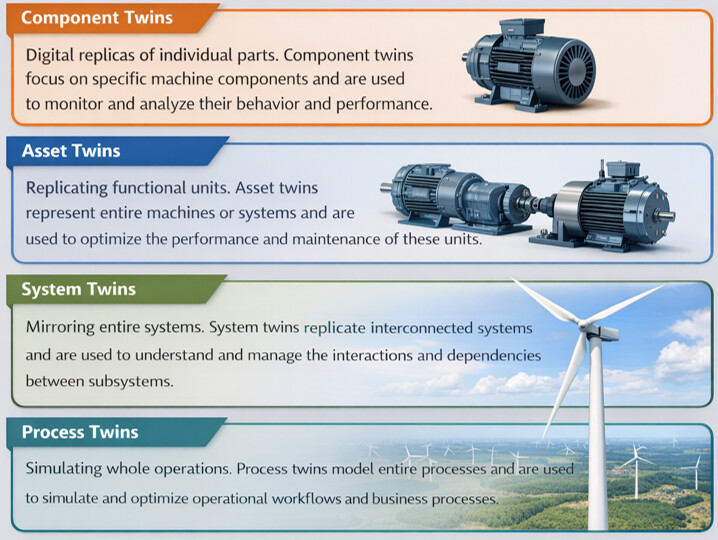
What are the types of Digital Twins
Main Benefits of Digital Twins
- Accelerated research and development: Experiment with different product designs, workflows and manufacturing processes within a virtual testing environment, accelerating innovation and reducing time to market.
- Greater efficiency: Digital twins can help mirror and monitor systems to achieve and maintain peak efficiency throughout the manufacturing process. Can also identify cost-cutting opportunities without interfering with current workflows.
- Enhanced oversight: A single malfunction or asset failure can cause widespread disruptions. Digital twins can address this problem by reflecting the real-time condition of individual components, including sensors, circuits and capacitors. By continuously communicating with the physical system, a digital twin can detect early warning signs.
- Scalability: Quickly accommodate shifting product demand, economic conditions and strategic priorities. Scaling up or down requiring teams to carefully validate new systems. Digital twins make this process faster and less risky by providing a virtual environment where teams can safely adjust parameters and test configurations.